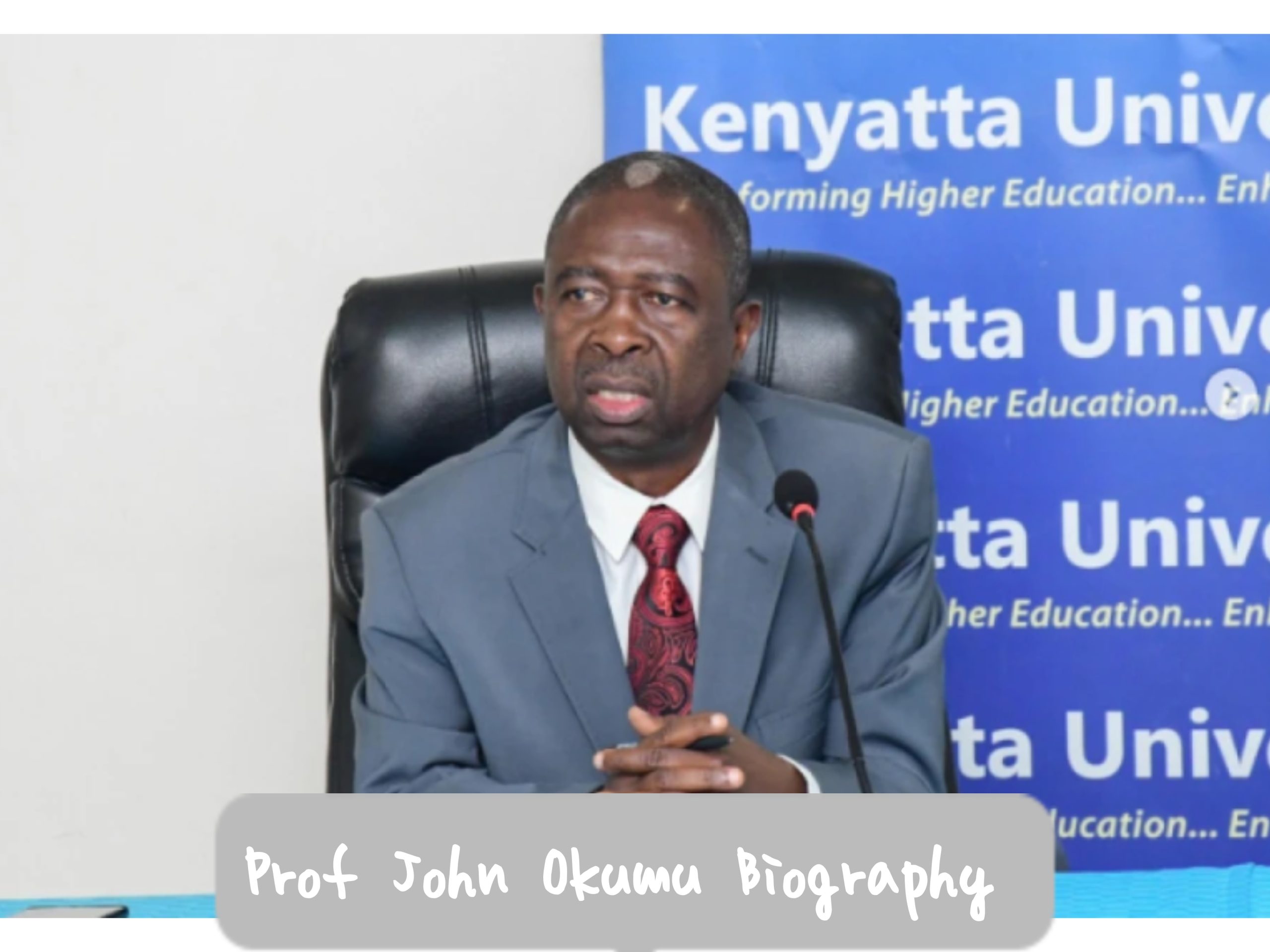
Professor John Okumu is a Kenyan physicist, academic leader, and the current Vice-Chancellor of Kenyatta University. Born and raised in Kenya, he has dedicated nearly four decades to the same institution where he began as a student, rising steadily through teaching, research, and administrative ranks to become one of the country’s most experienced university administrators.
His work in condensed matter physics, thin-film materials, and university governance has shaped both scientific understanding and higher education policy in Kenya. This biography traces his path from undergraduate student to full professor and institutional head, highlighting the steady accumulation of expertise that prepared him for the highest leadership role at one of Kenya’s largest public universities.
Prof John Okumu Early Life
Professor John Okumu was born and raised in Kenya. Specific details of his exact date of birth and childhood village remain private in publicly available records, yet his later academic choices and career path place him firmly within the Kenyan educational system of the late twentieth century. Growing up in a country then expanding access to secondary and tertiary education after independence, he developed an early interest in the physical sciences and mathematics. These subjects would later form the foundation of his entire professional life.
Kenya’s education system in the years of his youth emphasized science and teacher training as tools for national development. Okumu’s decision to pursue a Bachelor of Education degree with specializations in Physics, Mathematics, and Education reflected both personal aptitude and the national priority placed on producing qualified science teachers. His upbringing in Kenya therefore provided the cultural and educational environment that directed him toward Kenyatta University in 1983, the institution that would become the centre of his life’s work.
Prof John Okumu Education
Professor John Okumu’s formal higher education began at Kenyatta University in 1983. He enrolled for a Bachelor of Education (Science) degree, specializing in Physics, Mathematics, and Education. He completed the programme and graduated in 1986. The combination of pure science and pedagogical training prepared him both for laboratory research and for classroom teaching, a dual competence that later proved valuable in university administration.
Immediately after graduation he continued at the same university, registering for a Master of Science degree in Condensed Matter Physics. He completed the MSc in 1988. Condensed matter physics examines the physical properties of solid and liquid materials, a field that later became the core of his research on thin films and optical materials.
In 1992 Okumu travelled to the United Kingdom to undertake doctoral studies at the University of Leeds. He earned his PhD in Condensed Matter Physics in 1996. The years in Leeds exposed him to advanced experimental techniques and international research networks. Upon returning to Kenya he brought both specialized knowledge and a broader comparative perspective on how research universities operate.
His educational path is notable for its continuity. All three of his major degrees, except the doctorate, were earned at Kenyatta University. This deep institutional knowledge later enabled him to understand the university’s strengths, challenges, and culture from the inside.
Prof John Okumu Career
Professor John Okumu’s entire academic career has been spent at Kenyatta University. He joined the Department of Physics as a Tutorial Fellow in 1988, the same year he completed his master’s degree. Promotion followed steadily: Lecturer in 1992, Senior Lecturer in 1999, Associate Professor in 2004, and full Professor of Physics in 2020.
Academic Teaching and Mentorship
Throughout these ranks Okumu taught undergraduate and postgraduate courses in physics, supervised research students, and contributed to curriculum development. Former students have recalled his thoroughness in subjects such as quantum physics. His dual background in education and pure physics allowed him to communicate complex material clearly while maintaining rigorous scientific standards.
Research Contributions
His research centres on thin-film physics, nanoparticle optics, electron-scattering theory, and materials for optical and energy applications. Using sputter deposition techniques, he has studied transition metal oxides and photochromic materials. One of his most cited works, published in the Journal of Applied Physics in 2005, examined photochromic silver nanoparticles fabricated by sputter deposition. Other papers addressed gasochromic switching in molybdenum oxide films and theoretical calculations of electron scattering cross-sections.
He has published more than twenty-six papers in internationally refereed journals and eighteen articles in conference proceedings. He has also co-authored two books on electron impact excitation of atoms, both published in Germany in 2010. Research grants from the Third World Academy of Sciences (TWAS), the German Academic Exchange Service (DAAD), and the Alexander von Humboldt Foundation supported the establishment of a Thin Film Physics Research Unit at Kenyatta University.
Administrative Leadership Roles
Administrative responsibility grew alongside academic rank. Okumu served several terms as Acting Dean of the School of Pure and Applied Sciences in 2002, 2004, 2005, and 2010. Between 2003 and 2004 he was Deputy Director of Self-Sponsored Programmes, helping expand access to university education beyond government-sponsored students.
From 2004 to 2007 he served as Deputy Editor of the East African Journal of Science, and from 2007 to 2010 as Editor-in-Chief of the Physics section, promoting regional scientific publishing. He also chaired the Department of Physics and directed the Centre for Career Development and Placement.
In 2010 he was appointed Deputy Vice-Chancellor (Academic), a position he held for a decade. During this period Kenyatta University introduced seventy-seven new academic programmes, secured accreditation for five campuses, and grew student enrolment from approximately 45,000 to 74,000. He also served as Acting Vice-Chancellor on more than forty occasions when the substantive office holder was away. He chaired the Board of Postgraduate Studies and the E-learning Board, and cultivated partnerships with universities in Germany, South Korea, the United States, and Canada.
Appointment as Vice-Chancellor
In January 2026, following the end of Professor Paul Wainaina’s eight-year tenure, Okumu assumed the role of Acting Vice-Chancellor. On 27 July 2026 the University Council, chaired by Professor Clara Momanyi, appointed him substantive Vice-Chancellor with immediate effect. He emerged as the top-ranked candidate in a competitive process conducted by the Public Service Commission. He became the seventh Vice-Chancellor of Kenyatta University.
In accepting the appointment he pledged leadership marked by humility, integrity, and openness, committing to strengthen the university’s position as a premier Kenyan institution and a globally competitive university. The appointment came at a time of financial pressure on public universities, rising enrolment, and demands for greater relevance of academic programmes to national development needs.
Prof John Okumu Research Focus and Scientific Impact
Professor John Okumu’s scientific work belongs to the field of surface and materials physics. His recent research has concentrated on sputter deposition of thin films of transition metal oxides. The goal is to understand novel materials that can be used in devices such as smart windows, optical switches, and photovoltaic systems. Characterisation relies on optical spectroscopy and X-ray diffraction to link film structure with functional properties.
International recognition came through the Georg Forster Research Fellowship of the Alexander von Humboldt Foundation, which supported collaboration with Professor Matthias Wuttig at RWTH Aachen University in Germany beginning in 2002. That partnership produced several joint publications on photochromic and gasochromic materials. Membership in the Humboldt network continues to facilitate exchange opportunities for younger African scientists.
His theoretical work on electron scattering and autoionizing states of alkali atoms complements the experimental thin-film research, demonstrating breadth across both computational and laboratory approaches within condensed matter physics.
Prof John Okumu Contributions to Higher Education in Kenya
Beyond individual research, Okumu has shaped the broader landscape of Kenyan university education. As Deputy Vice-Chancellor (Academic) he oversaw quality assurance, curriculum reform, and the expansion of postgraduate training. The introduction of new programmes and the accreditation of satellite campuses increased access for students outside Nairobi. His editorial roles in regional journals strengthened the infrastructure for African scientific communication.
As Vice-Chancellor he inherits an institution that regularly admits the highest number of first-year students in the country through the Kenya Universities and Colleges Central Placement Service. Balancing financial sustainability with academic quality remains a central challenge. His long internal experience positions him to address these issues with institutional memory and practical insight.
Prof John Okumu Awards and Recognitions
Professor John Okumu has received research support and fellowships rather than a long list of named prizes. The most prominent recognition is the Georg Forster Research Fellowship from the Alexander von Humboldt Foundation. Additional grants from DAAD and TWAS enabled laboratory development and international collaboration. His elevation to full professor in 2020 and subsequent appointment as Vice-Chancellor constitute institutional recognition of sustained scholarly and administrative achievement. He is also a member of the Kenya National Academy of Sciences.
Prof John Okumu Personal Life
Public information about Professor John Okumu’s private life is limited. He has maintained a low personal profile, focusing public attention on his academic and administrative work. He lives and works in Nairobi, where Kenyatta University is located. Colleagues and former students frequently describe him as calm, thorough, and composed. These personal qualities have been noted both in classroom settings and in high-level university meetings. No detailed public accounts of family members appear in available sources, consistent with a professional preference for privacy.
Prof John Okumu Leadership Philosophy and Vision
In statements following his appointment as Vice-Chancellor, Okumu emphasized humility, integrity, and openness. He has spoken of the need to deliver quality education while leveraging emerging technologies, and of working collaboratively with staff, students, and external partners. His vision centres on strengthening Kenyatta University’s academic standing, expanding research and innovation, improving governance, and deepening links with industry and international institutions. Having served the university continuously since 1983 as student, lecturer, and administrator, he brings an unusually complete understanding of its culture and operational realities.
Conclusion
Professor John Okumu’s biography is one of deep institutional loyalty and cumulative achievement. From a Bachelor of Education student in 1983 to Vice-Chancellor in 2026, he has remained rooted at Kenyatta University while expanding his scientific reach through international collaboration. His research in thin-film physics has contributed to materials science, while his administrative record has helped shape curriculum, access, and quality assurance at one of Kenya’s major public universities. At a moment when Kenyan higher education faces financial and structural pressures, his appointment brings continuity, technical expertise, and long experience of the institution he now leads.
FAQs
Who is Professor John Okumu?
Professor John Okumu is a Kenyan physicist and the current Vice-Chancellor of Kenyatta University. He is a full Professor of Physics specializing in condensed matter and thin-film materials.
Where was Professor John Okumu born?
He was born and raised in Kenya. Detailed information about his exact place of birth is not widely published in public sources.
What are Professor John Okumu’s academic qualifications?
He holds a Bachelor of Education (Science) in Physics, Mathematics and Education (1986) and an MSc in Condensed Matter Physics (1988), both from Kenyatta University, and a PhD in Condensed Matter Physics from the University of Leeds (1996).
When did Professor John Okumu become Vice-Chancellor of Kenyatta University?
He was appointed substantive Vice-Chancellor on 27 July 2026 after serving as Acting Vice-Chancellor from January 2026.
What is Professor John Okumu’s main research area?
His research focuses on thin-film physics, sputter deposition of transition metal oxides, nanoparticle optics, photochromic and gasochromic materials, and electron-scattering theory.
How long has Professor John Okumu worked at Kenyatta University?
He has been associated with the university continuously since 1983, first as a student and then as a member of academic staff from 1988 onward.
Has Professor John Okumu published books?
Yes. He co-authored two books published in 2010 on electron impact excitation of helium and alkali atoms.
What international fellowships has Professor John Okumu received?
He held a Georg Forster Research Fellowship from the Alexander von Humboldt Foundation and has received support from DAAD and the Third World Academy of Sciences.