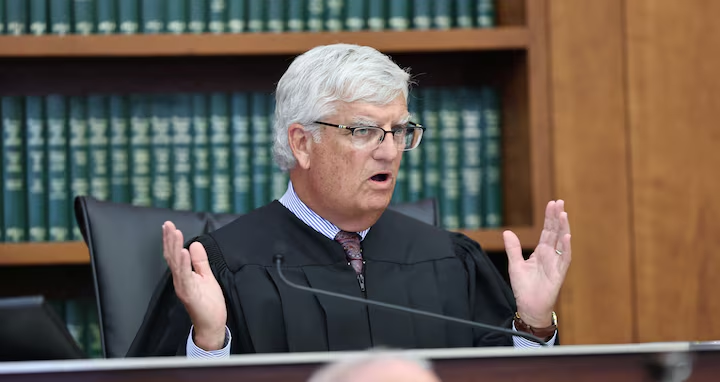
William Francis Sullivan is an American jurist serving as an associate justice of the Massachusetts Superior Court. Born in Boston, Massachusetts, he has spent his entire professional life in the state’s legal system, first as a prosecutor, then as a criminal defense attorney, and since 2014 as a trial judge.
Sullivan’s path reflects a deep commitment to Massachusetts courts and the communities of Norfolk and Plymouth counties. His work has included high profile murder cases on both sides of the courtroom and, more recently, complex trials involving questions of mental health and criminal responsibility. This biography presents the verified public record of his education, career, and service in clear and accessible language.
William Sullivan Early Life
William Francis Sullivan was born on June 15, 1957, in Boston, Massachusetts. Boston is the capital and largest city of Massachusetts, a state in the New England region of the northeastern United States. Massachusetts holds a central place in American history as one of the original thirteen colonies, the site of the American Revolution’s early battles, and a longstanding center of education, law, and public life. The state is known for its strong tradition of local government, its network of independent and public schools, and its dense concentration of colleges and universities. Sullivan grew up in this environment of civic awareness and educational opportunity.
He attended Xaverian Brothers High School in Westwood, Massachusetts, a Catholic secondary school that emphasizes academics, character, and service. After high school he enrolled at the University of Notre Dame in Indiana. At Notre Dame he played on the men’s soccer team and completed his undergraduate studies, earning a Bachelor of Arts degree in 1979. He then returned to Massachusetts for legal training and entered Boston College Law School. He received his Juris Doctor degree in 1982 and was admitted to the Massachusetts bar the same year.
Massachusetts provided the full setting for his formation. The state’s legal culture values thorough preparation, oral advocacy, and familiarity with both the criminal and civil sides of the trial courts. Sullivan’s early years in Boston and its suburbs, combined with the discipline of a Catholic high school and the competitive environment of Notre Dame athletics, prepared him for the demands of courtroom practice that would define his career.
William Sullivan Education and Path to the Bar
Sullivan’s undergraduate years at Notre Dame combined academic work with intercollegiate soccer. The experience of team competition and the university’s emphasis on ethics and leadership contributed to the practical outlook he later brought to legal work. Boston College Law School, located in Newton, Massachusetts, offered rigorous training in the common law tradition that governs the state’s courts. Upon graduation in 1982 he was ready to enter practice immediately.
Admission to the Massachusetts bar in 1982 opened the door to public service and private practice within the same geographic area where he had grown up. The continuity of place is notable. Many lawyers move between jurisdictions; Sullivan built his entire career inside the Massachusetts system.
William Sullivan Career
Sullivan’s professional life divides into three clear phases: early work as a prosecutor, a long period as a defense attorney in private practice, and service on the Superior Court bench.
Early Work as a Prosecutor
From 1982 to 1984 Sullivan served as an assistant district attorney in the Norfolk County District Attorney’s Office. Norfolk County lies just south of Boston and includes cities and towns such as Quincy, Brookline, and Dedham. As a young prosecutor he handled criminal cases in the district and superior courts, gaining firsthand experience with charging decisions, plea negotiations, and trial presentation. The two year period gave him a working knowledge of the state’s criminal statutes and the practical realities of bringing cases on behalf of the Commonwealth.
Private Practice and Criminal Defense
In 1984 Sullivan entered private practice in Quincy, Massachusetts. Over the following three decades he became a partner at the firm Sullivan and Sweeney, LLP. He concentrated on criminal defense and related civil matters. Public records and contemporary reporting describe him as having tried hundreds of Superior Court cases and having obtained acquittals in matters ranging from serious violent crimes to drug and motor vehicle offenses. He developed a reputation as a careful and experienced trial lawyer who understood both the prosecution and defense perspectives.
One of the most widely reported cases he handled as defense counsel was the 2013 murder trial of Nathaniel Fujita. Fujita, a young man from Wayland, Massachusetts, was charged with killing his former high school girlfriend. Sullivan presented a defense centered on the claim that Fujita had experienced a psychotic episode. The jury convicted Fujita, who received a life sentence. The case later received national attention and was covered in a television documentary. Sullivan’s work on the matter illustrated his willingness to handle difficult mental health defenses in high profile settings.
In addition to private practice, Sullivan served as a special assistant city solicitor for the city of Quincy from 2006 to 2008. He also participated in professional organizations, including service as president of the Norfolk County Bar Association and the Quincy Bar Association. From 2003 to 2007 he was a member of the Judicial Nominating Commission, the body that reviews candidates for judicial appointment in Massachusetts. These roles kept him connected to the broader legal community and to the process of selecting judges.
Appointment to the Massachusetts Superior Court
In April 2014 Governor Deval Patrick nominated Sullivan to the Massachusetts Superior Court. The Governor’s Council confirmed the nomination unanimously on May 21, 2014. The Superior Court is the statewide trial court of general jurisdiction that handles the most serious criminal cases, major civil disputes, and certain equity matters. Sullivan assumed the role of associate justice and has sat primarily in the Plymouth County and related sessions.
Massachusetts Superior Court judges face a mandatory retirement age of 70. As of 2026 Sullivan is approaching that limit while continuing to preside over active dockets. His docket has included complex murder trials that raise questions of criminal responsibility, mental health evidence, and jury management.
Notable Judicial Assignments
In recent years Sullivan has presided over two high profile cases involving mothers charged with killing their children and raising mental health defenses. One earlier matter resulted in a conviction that the Massachusetts Supreme Judicial Court later reviewed on issues related to the exclusion of mental health records, leading to further proceedings. In 2026 he presided over the trial of Lindsay Clancy in Plymouth Superior Court. Clancy faced charges arising from the deaths of her three children in 2023. The defense centered on claims of postpartum psychosis and lack of criminal responsibility. After weeks of testimony and jury deliberations that produced a deadlock, Sullivan declared a mistrial on September 4, 2026. The case drew extensive public and media attention and placed Sullivan’s courtroom management under close observation.
Throughout these assignments Sullivan has ruled on evidentiary questions, jury instructions, and procedural motions while maintaining the orderly progress of trial. His experience on both sides of criminal cases has informed his approach to the bench.
William Sullivan Professional Affiliations and Community Roles
Before joining the bench Sullivan held leadership positions in local bar associations and served on the Judicial Nominating Commission. He has been associated with the Massachusetts Bar Association and related professional groups. These activities reflect a sustained engagement with the improvement of legal practice and the selection of judges in the Commonwealth. Public sources also note his earlier involvement with community organizations and local government finance committees in the Canton area, where he has resided.
William Sullivan Awards and Recognition
Formal public records do not list an extensive set of named awards. Recognition has come primarily through professional standing within the Massachusetts bar, election to leadership of county bar associations, service on the Judicial Nominating Commission, and the unanimous confirmation to the Superior Court by the Governor’s Council. Colleagues and contemporary reporting have described him as a skilled and experienced trial lawyer prior to his appointment. The confidence shown by successive governors and the legal community constitutes the principal form of recognition in the public record.
William Sullivan Personal Life
Sullivan is married to Mary Lou Sullivan. The couple have three sons named Will, Conor, and Brennan. He has lived in Canton, Massachusetts, a town in Norfolk County. Outside the courtroom he is known as a sports enthusiast. Public profiles emphasize that he has kept family details largely private while maintaining a consistent presence in the local legal community.
The continuity of his personal and professional life within Massachusetts is striking. From Boston birthplace to Westwood high school, Notre Dame education, Boston College Law School, Norfolk County practice, and Superior Court service, Sullivan has remained rooted in the same geographic and institutional landscape.
William Sullivan Massachusetts Roots and Legal Context
Massachusetts has long been a center of American legal education and practice. Institutions such as Harvard Law School, Boston College Law School, and the state’s dense network of trial courts have produced generations of lawyers and judges. The Superior Court itself traces its authority to the colonial and early republican periods and remains the primary venue for serious criminal trials. Sullivan’s career unfolded entirely inside this system. His familiarity with Norfolk and Plymouth County practices, local bar culture, and the expectations of Massachusetts juries has been a consistent feature of his work.
The state’s mandatory retirement age of 70 for judges creates a defined horizon for service. Sullivan’s appointment in 2014 placed him on the bench for a period that has now spanned more than a decade of significant criminal cases. His dual experience as prosecutor and defense counsel is relatively uncommon among trial judges and has been noted in coverage of his high profile assignments.
Conclusion
William Francis Sullivan has built a complete career within the Massachusetts legal system. Born in Boston in 1957, educated at Notre Dame and Boston College Law School, he served as a young prosecutor, became a respected criminal defense attorney in Quincy, and was appointed to the Superior Court in 2014. His docket has included some of the most closely watched murder trials in the state in recent years. The public record shows a steady progression from courtroom advocate to trial judge, grounded in the institutions and communities of Massachusetts. This account rests solely on verified biographical and professional information available from official and contemporaneous sources.
FAQs
Who is William F. Sullivan?
William Francis Sullivan is an associate justice of the Massachusetts Superior Court. He was appointed in 2014 by Governor Deval Patrick after a long career as a prosecutor and criminal defense attorney in the state.
When and where was William Sullivan born?
He was born on June 15, 1957, in Boston, Massachusetts.
What is William Sullivan’s educational background?
He graduated from Xaverian Brothers High School in Westwood, earned a Bachelor of Arts from the University of Notre Dame in 1979, and received his law degree from Boston College Law School in 1982.
What positions did William Sullivan hold before becoming a judge?
He served as an assistant district attorney in Norfolk County from 1982 to 1984, practiced as a partner at Sullivan and Sweeney, LLP in Quincy, and worked as a special assistant city solicitor for Quincy from 2006 to 2008. He also served on the Judicial Nominating Commission from 2003 to 2007.
What high profile cases has Judge Sullivan handled?
As a defense attorney he represented Nathaniel Fujita in a 2013 murder trial that involved a mental health defense. As a judge he has presided over murder trials raising questions of criminal responsibility, including the 2026 trial of Lindsay Clancy that ended in a mistrial.
Does William Sullivan have a family?
Public information identifies his wife as Mary Lou Sullivan. The couple have three sons.